From Earth orbit to the Moon and Mars, explore the world of human spaceflight with NASA each week on the official podcast of the Johnson Space Center in Houston, Texas. Listen to in-depth conversations with the astronauts, scientists and engineers who make it possible.
On episode 430, Kim de Groh and Sylvie Crowell review what researchers have learned and published from the Materials International Space Station Experiment (MISSE) platform that tests how materials perform in the harsh environment of space. This episode was recorded in June 11, 2026.

Transcript
Dane Turner
Houston We Have a Podcast. Welcome to the official podcast of the NASA Johnson Space Center, episode 430: ISS Results: Materials Science. I’m Dane Turner, and I’ll be your host today. On this podcast, we bring in the experts, scientists, engineers, and astronauts, all to let you know what’s going on in the world of human space flight and more.
The International Space Station is an incredible research platform for many experiments that are just not possible on Earth. In its more than 25 years in orbit, we’ve learned a lot about living and working off planet, from the way the human body reacts to microgravity to keeping spacecraft functional across decades of use. Another thing the ISS can teach us is how materials react to different environments, particularly when exposed to the conditions in outer space, which is where the Materials International Space Station Experiment, MISSE for short, comes in. MISSE has been aboard the ISS in one form or another basically from the beginning, giving researchers insights into the performance of polymers, composites, thermal protection systems, photovoltaics, and radiation shielding technologies when exposed to the space environment.
To tell us more about what we’ve learned from exposing materials to space, we have Kim de Groh, retired senior materials research engineer, and Sylvie Crowell, materials engineer from NASA’s Glenn Research Center Environmental Effects and Coatings Branch.
Lets get started.
<Intro Music>
Dane Turner
Kim, Sylvie, thank you so much for coming on Houston We Have a Podcast today.
Kim de Groh
Thank you. I’m very happy to be here to talk about material science and the MISSE missions.
Sylvie Crowell
Thanks for having us.
Dane Turner
So, as we get started here, can you tell us a little bit about yourselves and your background? How you came to NASA?
Kim de Groh
Sure, I’ll start. I’m Kim, and I became interested in NASA and the space program as a young girl because my father, who was a biomedical engineer at a research hospital in Detroit, and my older brother Hendrick, both shared their interest in the space program with me. My father helped analyze some data taken on NASA astronauts for the early space program, and my brother used to paint some wonderful science fiction space paintings, and he wanted to be a medical doctor for astronauts, which I thought was really cool. But a really memorable time for us was when our family watched Neil Armstrong take the first step on the Moon back on July 21, 1969. We watched on a little black and white TV up at our family cottage, which is on Lake Michigan. It was about 10 o’clock at night, and the Moon was really bright and visible, and we ran back and forth between the TV and outside on the deck to look up at the Moon, so that had a really big impact on me watching that first step on the Moon back then with my family.
Fortunately, during my master’s program in material science at Michigan State University. My thesis advisor knew I was really interested in NASA, and he helped me to get a summer job at NASA Glenn back in 1986. During that summer, I met my future husband, Henry de Groh, who was a young NASA materials engineer conducting microgravity materials experiments in space on the shuttle. I found Henry’s experiments really fascinating, and after working at Glenn for the summer, I knew I wanted to conduct research at NASA with a dream of flying my own materials experiments in space. After I received my master’s degree, I was able to get a job as a contractor at NASA Glenn in 1988 and then I was hired as a NASA employee a year later in 1989. Since then, I’ve flown many material space exposure experiments on the shuttle, the Russian space station Mir, and on the International Space Station.
Sylvie Crowell
Hi, I’m Sylvie. I was born in Cleveland, Ohio, and I’ve been a local my entire life. So, getting to work at NASA Glenn Research Center was my dream. I attended Case Western Reserve University, and I graduated with my bachelor’s and then my master’s degrees in 2024 during my master’s program, I was hired as a pathways intern at Glenn, and when I got to NASA, my first project as an intern was actually helping Kim analyze data from her Materials International Space Station Experiments. I was really lucky to have Kim and others like her as mentors, when I was getting started at NASA, it was super inspiring to see the incredible history of scientific discovery enabled through space flight, and to see myself one day following in their footsteps. After graduation, I was hired full time as a materials engineer. I’ve been at NASA for three years now, and I love the work I do.
Dane Turner
So, materials science is both of your life’s work, but to me that the term sounds really broad. So, what is material science research?
Sylvie Crowell
That’s a great question. So, people often ask me, what is material science? What is materials research? Not many people have heard of materials as an engineering discipline, but I like to say materials is everywhere. Everything you see is made of a material- the products you buy in a store, the structures that keep your house standing, even the clothes you’re wearing. Everything needs materials to function.
The job of a material scientist is to understand how those materials work through testing, select the best materials for a specific application, and then even invent entirely new materials. Materials research involves understanding the chemistry of a material. What exactly is it made of, and how does that contribute to its properties? But chemistry is not the only thing a scientist has to pay attention to. Structure and processing are also just as important. Is the material crystalline or amorphous? Was it maybe 3D printed or was it cast? These can have big impacts on how the material performs.
The materials that Kim and I do research on need to be able to perform well in space, which is an extremely harsh environment. Through our research, we investigate how materials are impacted by the environment and how they degrade over time. We try to understand what caused the degradation, and then develop ways to counteract that, whether through modifying the materials to add protections or selecting more durable materials for a specific application.
Dane Turner
How did you both get interested in this field?
Kim de Groh
Well, in high school I did well in math, and I loved art. And then, as a college freshman at Michigan State University, I developed an interest in both chemistry and atomic physics, so I thought engineering would be a really good combination of these different fields. I took a course at Michigan State University called Introduction to Careers in Engineering, which was really helpful. And during one of the classes, the chairman of the Department of Material science showed us a piece of special wire called shape memory alloy, and he crumpled it into a ball, and then he heated it with a lighter, and it magically formed into a perfect coil, and I found that material fascinating. And so I thought that I would try materials engineering and I ended up loving all my material science classes. Then, between my junior and senior years, I obtained a summer job at Clark Equipment Company, conducting metallurgical failure analyses, and that summer job, doing lab work and testing helped to confirm my interest in materials research,
Sylvie Crowell
So I was also always interested in science as a little kid. I can remember a specific time. I really loved it when my mom would take me to the Great Lakes Science Center Museum in Cleveland, and that’s where I grew up, which also doubled as the NASA Glenn Visitor Center. So there were artifacts there from the Apollo missions, from the Mars rovers, and even the International Space Station experiments. But little did I know, I’d actually be contributing to some of that work, specifically the International Space Station experiments in my future career. Interestingly enough, it’s possible that the ISS experiment exhibit that I saw as a kid might have actually been something that Kim contributed to.
Similarly to Kim, I was good at math and science as a kid, but I also really loved the arts. I was actually kind of torn between doing music or art school versus pursuing engineering. It was a summer camp that helped me decide which direction to go in. I attended a materials science summer camp in high school, where students got to play around with microscopes and look at materials microstructure, and I was totally hooked after that. I declared materials engineering as my major as soon as my advisor allowed me to at Case when I went to undergrad there.
As an undergrad, I explored the different facets of materials engineering through several different internship and research opportunities. I’ve been able to get a taste of what it’s like to work in industry, academia, and government, and I’ve been able to work on several different material systems.
Dane Turner
it sounds like there’s a lot of applications for this, but what kinds of materials research do you focus on here at NASA?
Kim de Groh
So, for my 36 years of materials research at NASA, I focused primarily on the durability of spacecraft materials in the low earth orbit space environment. As Sylvie mentioned, space is an extremely harsh environment, and materials on the outside of spacecraft or space structures can be degraded by the different types of environmental exposures. My research focused on atomic action erosion, radiation embrittlement, and discoloration of spacecraft materials. And for the past 25 years I conducted research through space flight experiments, such as the MISSE experiments that we’ll be discussing.
I also, though, studied a variety of other interesting spacecraft materials, including the embrittlement and cracking of thermal insulation blankets covering the Hubble Space Telescope. Hubble had five servicing missions, and during each of the servicing missions, astronauts brought back pieces of insulation, and I was part of a small team analyzing the material to understand why it was becoming embrittled up in the space environment.
I also evaluated degraded materials retrieved from the Russian space station Mir after 10 years in space. I helped develop highly emissive heat receiver coatings, so very black coatings for solar dynamic power systems early in my career, and I also conducted ion thruster engine wear analyzes for deep space propulsion missions. So I got to do a really wide variety of different kind of materials research.
Sylvie Crowell
That’s awesome. So I’m picking up kind of where Kim left off in a way, continuing the MISSE experiments to investigate new materials and how they are impacted by the space environment. In addition to my International Space Station MISSE work, I also am working to develop lunar dust mitigation coatings, and those help prevent dust from sticking to solar cells and thermal control surfaces on the Moon.
Dane Turner
It sounds like there’s a lot of materials research that’s done on earth to develop new kinds of interesting things, but why do we do materials research on the space station?
Kim de Groh
Yeah, so as I mentioned, materials used outside of spacecraft are subjected to environmental threats that can cause degradation. In low Earth orbit, which is where space station and the Hubble Space Telescope orbits, these threats include different kinds of radiation, such as UV or ultraviolet radiation, photon radiation, X-rays, solar wind particle radiation, which are electrons and protons, and cosmic rays. But there’s also temperature extremes, thermal cycling, debris impacts, spacecraft self-contamination, and atomic oxygen. Atomic oxygen are highly reactive oxygen atoms, and so these environmental exposures can result in various types of materials degradation, such as erosion and embrittlement, and changes in optical properties, which can threaten spacecraft performance and durability. Now, fortunately, ground laboratory testing can be very helpful, and it can simulate many of these types of environmental exposures. However, differences exist between the ground facilities and being up actually in space. In space, you have all those different environmental exposures combined at one time, and so, because you can’t simulate that perfectly in a ground test facility, the results are different for some material responses in a ground test facility than it is up in space. Therefore spaceflight data are needed to validate the durability of a material for a spacecraft mission. In addition, though we can use material space flight experiments to determine correlations or validations between exposures and ground test facilities and the space exposure, so that allows for more accurate predictions of in-space performance based on ground testing, which is really good. Now, over the years, material space flight experiments have been flown on different types of spacecraft, such as the shuttle, a facility called the Long Duration Exposure Facility, or LDEF, outside the Russian space station Mir, and other spacecraft. But since 2001, so for the past 25 years, experiments have been flown as part of the Materials International Space Station experiment or MISSE missions on the outside of space station. And one of the benefits to flying materials experiments on the space station is that the experiment can be returned to the investigator for post-flight analyses, which is very important and helpful.
Dane Turner
You mentioned atomic oxygen there, and I just want to know, how is atomic oxygen different from the oxygen that’s in our atmosphere?
Kim de Groh
So, atomic oxygen is a single oxygen atom, where the oxygen that we’re breathing is two atoms together, so it’s a molecule, and the oxygen up in space this atomic oxygen is very reactive. And spacecraft travel at such a fast speed that they literally ram into these oxygen atoms, and that can cause certain materials to oxidize and erode and so you can get erosion of materials due to this unique single oxygen atom up in the space environment. And I don’t know if Sylvie wants to add anything to that.
Sylvie Crowell
Sure, yeah, I would just say, as Kim said, it’s a highly reactive single atom of oxygen. So ozone is O3 we also think of ozone as being kind of nasty stuff, super reactive ox, atomic oxygen is just O, and we don’t really encounter that here on earth, because when an O atom meets another O atom, it wants to make O2 but in low earth orbit the pressure is lower in the vacuum of space, so the O atoms, they don’t really hit each other, they hit materials. And when they hit those materials, they react with those materials, oxidize them, and that can actually degrade and even completely disintegrate certain materials over time.
Dane Turner
That’s fascinating. So, on the International Space Station, there’s an experiment platform called the Materials ISS Experiment Flight Facility, or the MISSE FF. So, what is it, and where is it?
Kim de Groh
Yeah, so first I’d like to say that the MISSE International Space Station Experiment, or MISSE program, involves a series of space flight missions with experiments flown on the outside of space station to test the performance and durability of materials and devices exposed to the low earth orbit space environment.
Now in the early missions, which were when the shuttle was flying, the MISSE 1 through 8 missions, individual flight experiments were flown in suitcase-like containers called Passive Experiment Containers, or PECs. The PECs were placed outside the space station in various locations by an astronaut during a spacewalk. They would be positioned in either a ram, wake, or a zenith nadir flight orientation, which we’ll talk about a little bit later, but they would be exposed for one to four years. And then after the mission exposure, the carriers or PECs would be retrieved also during a spacewalk and returned on the shuttle for post-flight analysis.
The MISSE missions are now being flown on the MISSE Flight Facility, or MISSE FF, which is one of space station’s permanent external material science platforms. The MISSE Flight Facility is operated by Aegis Aerospace, and it is a modular and robotically serviceable external facility that is located on the Express Logistics Carrier 2 Site 3, so that’s ELC 2 site 3. The MISSE Flight Facility provides ram, wake, zenith, and nadir space exposures for material and depth device experiments, and this is important, because the flight orientation highly affects the environmental exposure. For example, the ram-facing surfaces, which are facing the direction of travel, receive a high flux, or a high amount of atomic oxygen, these oxygen atoms, and a moderate amount of solar exposure or sunlight, whereas the wake-facing surfaces, which are facing away from the direction of travel, receive essentially no atomic oxygen and moderate solar exposure. So material responses can be very different in the ram or wake directions for the same material, the zenith direction, or the zenith surface, is facing out to space, and it gets the most sunlight, and nadir surfaces, which are looking down towards Earth, get the least amount of sunlight, but all those surfaces receive charged particle and cosmic radiation.
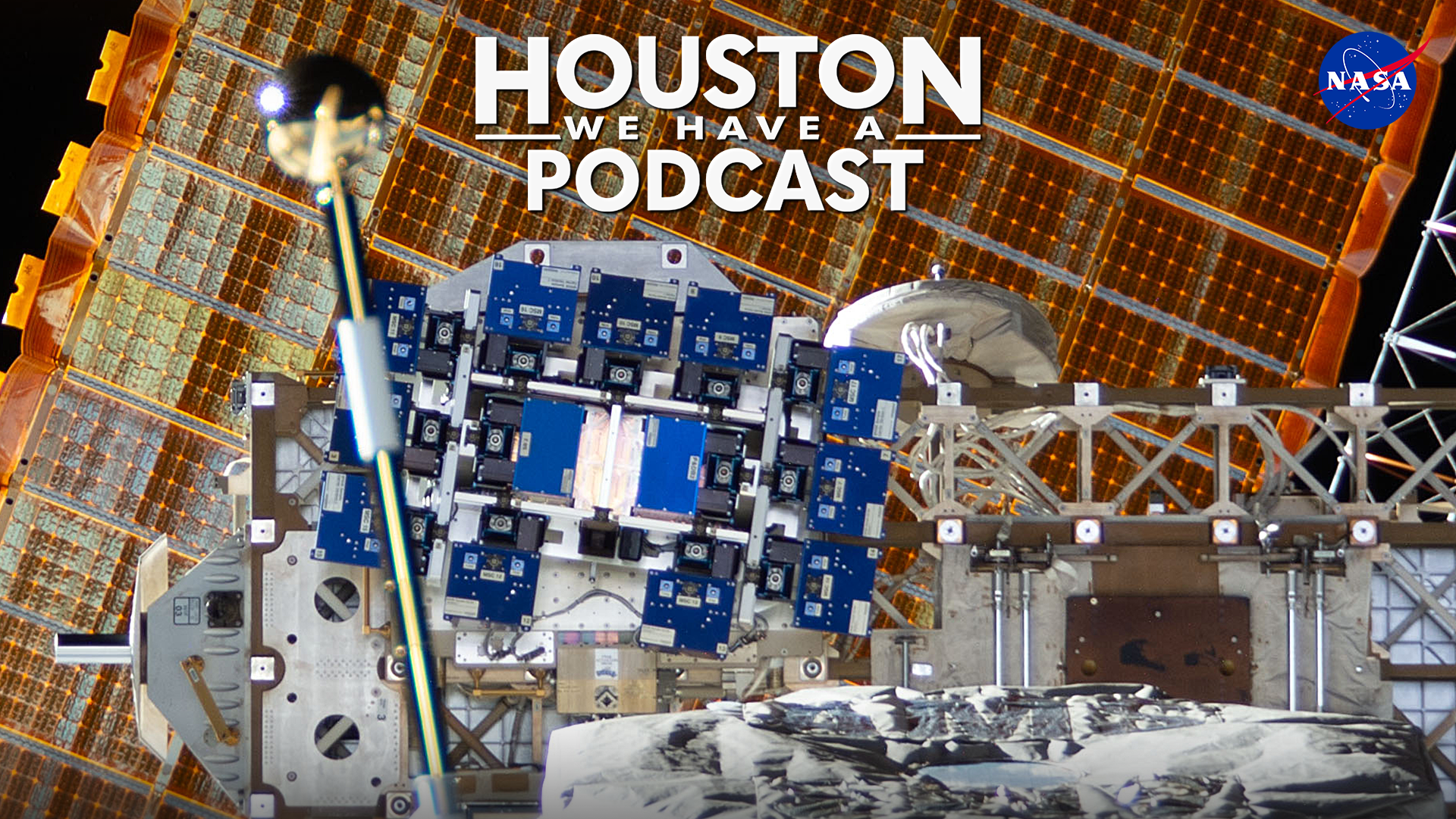
Now the MISSE Flight Facility supports both passive and active experiments. A passive experiment is one that does not take any data while it’s up in space, while an active experiment will record some kind of data over time. The MISSE Flight Facility has sensors that provide environment data over time, including temperature, contamination, and solar exposure. Another really nice feature of the MISSE flight facility is that it includes on-orbit facility cameras that provide monthly sample images. MISSE sample carriers, also called MISSE science carriers or MSCs, which look like a large blue rectangular box, house the MISSE flight experiments, and each of these MSCs or carriers has two sides with a central hinge, so it can be closed for launch to protect the samples, and then it’s open remotely once on the MISSE flight facility.
The MISSE flight facilities are launched up on Cygnus or the SpaceX Dragon capsule and taken inside space station by the astronauts. The trays are then moved outside space station through the Kibo Japanese Experiment Module airlock on a facility called the MISSE Transfer Tray. The carriers are then installed on the MISSE flight facility structure using Space Station’s robotic arm. Once it’s on the MISSE Flight Facility, the MSCs or carriers, are remotely open to expose the experiment samples to the space environment, and those carriers are closed during ship dockings and local spacewalks to prevent contamination and minimize atomic oxygen exposure on surfaces we don’t want them to get atomic action like the wake surfaces.
So the MISSE flight facility and the first set experiments called MISSE 9 were launched on SpaceX-14 in April of 2018 The MISSE flight facility was robotically installed on ELC 2 site 3 on April 8 of 2018 and that first set experiments, the missing nine experiment samples were deployed or open to space on April 19, 2018 for a one year space exposure mission.
Dane Turner
You mentioned this is at ELC two site three. Now, I, I have a mental image of the space station, but I don’t know where that is. Are you able to give us a little bit more direction of where this facility is housed on the space station?
Kim de Groh
Yeah, I think the best way I could describe it is if you’re looking at space station and it’s coming towards you during flight, you can see these two long truss structures that are to the left and the right, and at the end of those truss structures are the solar arrays, and so ELC 2 site 3 is down the truss structure to the left on the top, kind of towards the solar array, and I think that’s about the best I can describe it.
Dane Turner
That that is a really good description for orienting, if you’re looking at the space station there. So this is on top of the space station, out near the solar arrays, just exposed to space.
Kim de Groh
Yes, exactly. Yes.
Dane Turner
So it’s just exposed to space there. And how does your team use the platform for research?
Kim de Groh
Well, we first submit an experiment proposal when there’s a call for NASA MISSE experiments that is released for a particular MISSE mission. If our experiment proposal is selected for flight, we prepare and pre-flight characterize experiment samples that are flown as part of that particular MISSE mission, along with other experiments. The samples are integrated into the carriers down in Houston in a clean room, and then they’re launched to space and exposed to the space environment on the MISSE flight facility for some duration, typically now it’s six months. After the mission. The experiment samples are retrieved and returned to us for post-flight analyzes, and then we test the samples in lab to see if they were durable in space or if they became damaged. And we write about our results, so that spacecraft designers can use the data for spacecraft material selection.
Dane Turner
You’ve been part of several of these MSSE experiments. What’s the goal of this series, and can you share a few of your favorite findings?
Kim de Groh
Sure, since 2001 I’ve been the principal investigator for 18 MISSE experiments with 700 samples that were successfully flown on the space station, including five experiments with 367 samples on the MISSE flight facility. Although my MISSE experiments have had numerous objectives, many of the samples were flown to increase our understanding of atomic oxygen erosion and radiation-induced embrittlement of spacecraft materials. For example, I would fly samples to characterize how quickly a material will erode in the space environment. So, how do we do that? We do that by determining a property that we call the atomic oxygen erosion yield of the material, and the atomic oxygen erosion yield is the volume of material that is removed through oxidation, and it’s measured in units of centimeters cubed per incident oxygen atom. Atomic oxygen erosion in low Earth orbit can be a serious threat to spacecraft performance and durability, so it’s essential to know the erosion yield of a material, so that the durability of that material can be determined for a spacecraft mission.
Now, one of the interesting findings from our experiments is that this erosion yield for some of the materials, but not all of them, can vary with the amount of atomic oxygen or with the amount of solar exposure it receives, and that was something we didn’t really expect. Now, a fun fact is that all of my early MISSE experiments, my MISSE 1 through 8 experiments, were collaborative efforts with high school girls from Hathaway Brown School in Shaker Heights, Ohio. I worked with 32 young women over 24 years as part of the Peace Team, which was named after our first MISSE experiment. Many of the students spent their entire high school career working with me on the MISSE flight experiment, so that was really exciting and fun. Now our first MISSE experiment, called the MISSE Peace Polymers experiment, and that acronym PEACE was for Polymers Erosion And Contamination Experiment. It exposed 40 different types of polymers to the low earth orbit ram atomic oxygen environment for four years. Many of our materials were highly degraded and eroded after four years in space. Several of the light-colored samples turned dark, and some of the silicone materials now glow when you shine a UV light on it, and the ground-based material doesn’t glow, so something occurred in the in the space environment to make the material glow. So that’s very interesting.
Now I will share that I’m really proud of the fact that the results from our first MISSE experiment are the basis of a NASA technical handbook that I wrote with my co-investigator Bruce Banks and one of the Hathaway Brown students Katherine McCarthy, and the handbook is called The Spacecraft Polymers Atomic Oxygen Durability Handbook, and it provides low Earth orbit atomic oxygen materials degradation data to spacecraft designers.
Now, for my recent five MISSE flight facility experiments, I had 49 different sample collaborators from 21 different organizations, and so we flew a really wide variety of different samples, including samples for atomic oxygen and radiation embrittlement, but also we flew some uncoated and coated docking seal samples, including some samples with protective coatings developed by my husband, Henry. I flew some cosmic ray shielding samples and shape memory polymer composite samples on each mission that were provided from a colleague at the University of Rome, and those were being looked at for space structures and spacesuits. We flew solar sail materials, we flew some shape memory alloys for lunar and Martian rover tires and actuators that were developed at Glenn. We flew low and high density polyamine aero gels, a variety of specialty coatings and conductive coatings, and some bio composite materials also.
Sylvie Crowell
When I first started at NASA, I assisted Kim with sample characterization and data analysis for her MISSE Flight Facility experiments. Under Kim’s mentorship, I was able to learn about the entire process. Since Kim’s retirement last year, I proposed my first ever MISSE experiment, which was selected to fly to the International Space Station as part of the MISSE 23 experiment. It contains 40 samples, and our goal is to study the space degradation of a wide variety of polymers, ceramics, and coatings with potential space applications. This work will support the development and selection of new cutting-edge materials that could support future space stations and lunar missions.
Dane Turner
When you’re getting ready to do one of these experiments, what is the kind of process you have to go through, and what’s your role in the experiment from beginning to end.
Sylvie Crowell
Sure, once we’ve selected which materials to fly on the experiment, we have to obtain the materials from their manufacturer or from the researcher who’s developing them, depending on how mature the material technology is. Next, we need to cut the materials to a specific size, which will fit into the MISSE flight holders. Usually, this is a small one inch disk. Then we do extensive pre-flight characterization on all of the samples to understand their properties before being exposed to space, that way after they return from space, we have a baseline to compare to. The pre-flight characterization often includes taking extremely precise mass measurements, measuring optical and thermal properties, and taking microscope images, among other things.
Dane Turner
Are you able to monitor these samples while they’re on the station?
Sylvie Crowell
Yes, so while the samples are on the International Space Station, we do get monthly photos of the samples to monitor how they’re doing. We also, as Kim mentioned, get data on the temperature, the ultraviolet exposure levels, and contamination present in the facility.
Dane Turner
And how long do they stay on station?
Sylvie Crowell
So, current mission durations are about six months long.
Dane Turner
So, when the samples get back to Earth, what happens then?
Sylvie Crowell
When the samples return to Earth, they will be characterized to determine how they were impacted by exposure to the space environment. This often includes repeating all of the pre-flight characterization measurements and comparing the data to see what properties may have changed. Some samples may have lost mass due to atomic oxygen degradation. Some may have darkened in color due to ultraviolet exposure. There might be cracks present from thermal cycling, or even tiny holes from micrometeor impacts. All this data is used to understand how the material responds to its environment. Eventually, the resulting publications will be used to inform material selection decisions for future space missions.
Dane Turner
I’d like to take a closer look at the MISSE-13 NASA experiment. It’s an investigation that took place in 2019 and through 2020 can you give me a small summary of the objectives of that investigation?
Kim de Groh
Sure, so my MISSE-13 experiment was one of a set of four experiments, actually called the Polymers and Composites Experiment 1 through 4 or PCE-1 through 4. The first one was flown as part of the MISSE-9 mission. First mission on the MISSE flight facility. The second one was flown as part of the MISSE-10 mission. The third was flown as part of the MISSE-12 mission, and the fourth, the PCE-4, was flown as part of the MISSE-13 mission, so the MISSE-13 PCE four experiment was a passive experiment with 98 samples flown in the wake and zenith directions, and the primary objectives were to determine optical and mechanical property degradation of spacecraft materials, and to assess the functionality of various materials after radiation exposure in low earth orbit, such as shape memory alloys, shape memory polymer composites, and melanin-based composites, similar to the PCE-1 to 3 experiments, samples were included to determine the atomic oxygen fluence and on-orbit contamination in each flight orientation. In addition to the typical one inch samples, there were also tensile samples for post-flight radiation embrittlement studies.
Dane Turner
So, how did this build upon previous research and the results over the course of the series?
Kim de Groh
Each of my MISSE experiments has built on the results of prior experiments. For example, if one sample was overly eroded in one experiment, I would fly a thicker layer of the material on a following mission. Each experiment always included new materials of interest to NASA and the space community, and my co-investigator for most of my experiments was Bruce Banks, and so we would jointly work together deciding which materials would be flown. Sometimes I would fly the same material on numerous missions or in a different flight orientation to see if the erosion yield from atomic oxygen would vary with the level of atomic oxygen exposure, or with the amount of solar exposure.
Dane Turner
I saw there’s a paper published recently with some of the results of the MISSE-13 is talking about that some of the specific biomaterials were infused with different types of melanin, including animal, fungal, and synthetic. Now I’m really only familiar with melanin as a thing that gives human skin color and in relation to sun tans. So, can you explain to me what melanin is and why researchers are experimenting with it in materials?
Kim de Groh
Sure, I’d like to first point out that my colleagues from Johns Hopkins Bloomberg School of Public Health, the University of Akron, and Red House Studio LLC in Cleveland are the experts on the melanin and mycelium samples and studies, so I do want to give them credit.
But melanin is a natural pigment found in a wide range of organisms, including fungi. It possesses unique physical and chemical properties that serve multiple biological functions, from radiation protection to energy capture and visual communication. The most notable of these is melanin’s ability to protect against radiation damage, acting as a natural sunscreen. Many black fungi can be found thriving in extreme environments, such as polar deserts and the damaged area of the Chernobyl nuclear reactor.
Fungal melanin has been shown to protect yeast from space flight effects, as well as from other chemical and mechanical stresses. It actually absorbs the entire solar irradiance spectrum, from the ultraviolet to the infrared, effectively capturing heat from solar radiation, which provides a survival advantage in cold environments. Melanin also provides mechanical strength to fungal cell walls, and these properties combined with others, such as its electrical properties and the fact that melanin can be produced both biologically and synthetically, make melanin polymers an intriguing material to explore for space applications.
Now, another bio-based material of interest for both earth and space applications is fungal mycelium. Mycelium is the root like part of a fungus. It consists of a vast three-dimensional branching network of microscopic thread like structures called hyphae. This unique morphology imparts several desirable properties to mycelium-based composites, including structural integrity, it’s lightweight, and it has versatility in when it’s being processed. Fungal mycelium is being developed currently into numerous products, including fungal leather, foam, and wood. And like fungal melanin, the mycelium can be cultivated and processed using minimal resources, potentially enabling the production of materials directly in space, thereby reducing the need for transportation from Earth.
These two biological materials present promising research and development opportunities for space applications, particularly with radiation protection, but their performance and survival in the space environment needs to be explored. I got to see a very interesting presentation on these materials at Glenn, and so I proposed that we fly samples of these materials as part of my MISSE-12 and also MISSE-13 experiments.
Dane Turner
That is fascinating. So, what is it exactly this experiment was doing?
Kim de Groh
Well, for this particular study, we evaluated the structural stability and radiation shielding effectiveness of biocomposite disks composed of a biodegradable polymer, PLA, which is Poly Lactic Acid, and that’s used widely in additive manufacturing, which is a process being looked at for space structures and space applications. And PLA is derived also from renewable resources, such as cornstarch.
So we flew a variety of samples, including PLA by itself with nothing infused in it, and then we flew some PLA samples infused with fungal melanin. We flew a sample with PLA infused with octopus ink melanin. We had samples infused with synthetic melanin. And we also flew compressed mycelium coated with a thin layer of the PLA. So another thing we did with this experiment was all samples that were flown were flown with a thin layer of Polyvinyl Chloride or PVC backing layer, because I found in my prior experiments that PVC, which is normally clear, would turn very dark brown quickly up in the space environment due to the solar radiation, so it’s very sensitive to color changes. So we use that as a way to look at the shielding effectiveness of these samples.
So we prepared two sets of samples, and once it was exposed in a zenith facing direction during the MISSE-12 mission for about a half a year, and one set was exposed in a wake facing direction during the MISSE-13 mission for about a half a year. And then post flight analyzes comparing flight exposed samples to earth controls assess changes in mass and optical properties, changes in the surface morphology, and the shielding effectiveness, and the results revealed that the differences were influenced by the sample composition and the flight orientation, with the findings suggesting that combining the PLA with the fungal melanin enhanced the stability and protection of the PLA in the LEO space environment.
Dane Turner
It sounds like, besides the PVC, the- all these materials we were testing were biomaterials. So, why are biomaterials important to space exploration?
Kim de Groh
Bio-inspired approaches have emerged as a promising strategy for dealing with the harsh environment of space. Bio-composites derived from biological sources offer several advantages over conventional materials, including being lightweight, they have sustainability, off-planet bio-manufacturing potential, and other unique properties, such as self-repairing, flexibility, and adaptability to different environmental conditions. However, the development of bio-composites and the testing of their performance in space are still in their infancy.
Dane Turner
So, why are the results of MISSE-13 significant to human space flight, but also to us people on the ground?
Kim de Groh
Well, as humanity ventures further into space, the need for innovative, lightweight, and sustainable materials becomes increasingly critical. The results from these flight samples present the first evaluation of melanin-containing PLA bio-composites exposed to the extreme conditions of low Earth orbit. The results reveal that fungal melanin enhances the structural stability of PLA, offering protection against space radiation and other environmental stressors by demonstrating the combined radiation shielding and structural resilience of these bio-composites, this research advances the understanding of biologically derived materials in space environments and highlights their potential for supporting sustainable long-term space exploration. So it is very promising research.
Dane Turner
We’re going to look ahead here. What’s your team flying next?
Sylvie Crowell
Sylvie here. So, as I mentioned briefly earlier, I am the principal investigator for a MISSE-23 experiment. This experiment is called Durability of Coatings, Polymers, and Ceramics for Space Applications, and it includes 40 samples. We will be launching in December 2026 to the International Space Station. Our team has several sample collaborators across multiple NASA centers and industry partners. Each collaborator contributes material samples and expertise to the experiment. There’s a lot of really cool materials flying in this upcoming experiment. I’m especially excited to be flying some samples of the lunar dust mitigation coating that my team is working to develop. We hope to learn more about this coating’s ability to withstand UV radiation and thermal cycling in space.
Dane Turner
I know you just mentioned that lunar dust mitigation coding, but what is it generally that excites you most about future materials research at NASA?
Sylvie Crowell
Yeah, I think the most exciting thing about getting to be part of materials research at NASA is how transformative it can be. As I mentioned earlier, materials are part of everything. Every mission NASA flies, every astronaut suit, solar array, and every rover tire, they all rely on materials to do the job. Getting the chance to develop a new material is the opportunity to completely transform the way a mission can work. The materials often are what set the limits of what we can do in a mission. How much stress can they withstand? How hot can they get? So, being able to push those limits and even completely change them makes it possible for NASA to go farther and to explore the places that we never thought we could go.
Dane Turner
As we wrap up today, I’d like to encourage our listeners to dive deeper into the incredible science happening every day aboard the International Space Station. You can explore a wide range of groundbreaking research, including cognitive neuroscience, stem cell research, and material science, like we talked about on this episode, and much, much more by visiting nasa.gov/stationresults, where new findings and mission updates are published regularly. Kim, Sylvie, thank you so much for joining us today.
Kim de Groh
You’re welcome. Thank you so much for inviting us. It was really fun.
Sylvie Crowell
Thanks for having us. It was a pleasure.
Dane Turner
Thanks for sticking around. I hope you learned something new today.
You can check out the latest from around the agency at nasa.gov. And our full collection of episodes and all of the other wonderful NASA podcasts can be found at nasa.gov/podcasts.
On social media we’re on the NASA Johnson Space Center pages of Facebook, X, and Instagram. If you have any questions for us or suggestions for future episodes, email us at nasa-houstonpodcast@mail.nasa.gov.
This interview was recorded on June 11, 2026.
Our producer is Dane Turner. Audio engineers are Will Flato and Daniel Tohill, and our social media is managed by Leah Cheshier and Kelsey Howren. Houston We Have a Podcast was created and is supervised by Gary Jordan. Special thanks to Nicole Rose, Destiny Duran, Christine Giraldo, and Jenny Hamilton for helping us plan and set up this interview, as well as the team at NASA’s Glenn Research Center, Lilly Shauntina, Jan Wittry, Duane Hurd, Bill McKinney, and Hugh Aylward for helping us record. And of course, thanks again to Kim de Groh and Sylvie Crowell for taking the time to come on the show.
Give us a rating and feedback on whatever platform you’re listening to us on, and tell us what you think of our podcast. We’ll be back next week.
3… 2… 1… This is an official NASA podcast.