Going Rogue
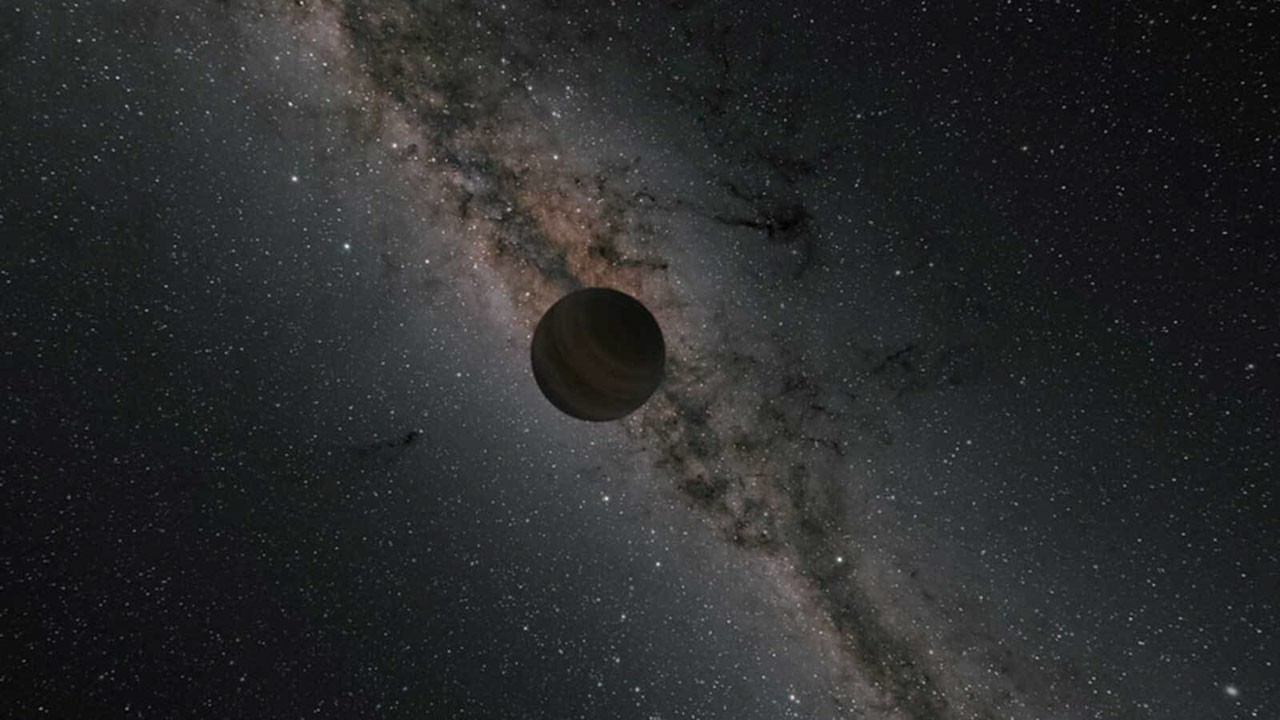
In a single generation, we went from knowing of only our own planetary system to realizing that planets likely outnumber the hundreds of billions of stars in our Milky Way galaxy. Recent research suggests that rogue planets — worlds that don’t orbit a star — are by far the most common type, outnumbering star-bound worlds by about six to one. That means there are likely trillions of worlds wandering alone across our galaxy.
By finding and studying these galactic nomads, Roman will help us understand more about how planetary systems form, evolve, and break apart.
NASA/JPL-Caltech/R. Hurt (Caltech-IPAC)
A Wrinkle in Space-Time
Astronomers usually find planets by seeing their effects on their host star, like how their gravity makes the star wobble or how crossing in front of their star as they orbit dim its light. But what if there’s no star to monitor?
Rogue planets don’t shine like stars and are often very cool objects, emitting too little heat for infrared telescopes to see. These vagabond worlds are essentially invisible, but they can’t hide their gravity.
A planet-hunting technique called microlensing reveals worlds thanks to wrinkles in space-time. This light-bending phenomenon occurs when a massive object like a star, planet, or black hole — any object with sufficient gravity — closely aligns with a background star from our vantage point. Light from the distant star curves as it travels through the warped space-time caused by the nearer object’s mass.
If the alignment appears especially close, the nearer object acts like a cosmic lens, focusing and magnifying light from the background star. Astronomers see the effect as a tiny surge in the star’s light.
NASA’s Goddard Space Flight Center/CI Lab
While most planet-hunting methods are best at finding scorching worlds tightly hugging their host star, microlensing is better at detecting worlds in orbits larger than Earth’s. That includes planets that whirl around their stars farther away than Neptune orbits the Sun and ones that have been kicked out of their original star systems altogether, now destined to roam the galaxy all alone.
But the microlensing signal from a rogue planet only lasts between a few hours and a couple of days before it’s gone forever. That makes them difficult to observe from Earth, even with multiple telescopes. That’s where Roman comes in.
Since Roman will observe above the atmosphere, nearly a million miles away from Earth in the direction opposite the Sun, it will yield far superior microlensing results. In addition to providing a sharper view, Roman’s perspective will allow it to stare at the same patch of sky continuously for months at a time. And with a view that matches Hubble’s while capturing at least 100 times more sky area per image, Roman’s Galactic Bulge Time-Domain Survey will monitor hundreds of millions of stars, which should reveal hundreds of rogue planets.
Lessons from Cosmic Castaways
Roman can detect rogue planets with masses as small as Mars. Studying these planets will help narrow down competing models of planetary formation.
The planet-building process can be chaotic, since smaller objects collide with one another and sometimes stick together to form larger bodies. It’s similar to using a piece of playdough to pick up other pieces. But occasionally collisions and close encounters can be so violent that they fling a planet out of the gravitational grip of its parent star. Unless it manages to drag a moon along with it, the newly orphaned world is doomed to wander the galaxy alone.
Less massive planets aren’t tethered as strongly to their star, so they’re more likely to be flung away into space. One study suggests Roman could find 400 rogue planets with masses similar to Earth’s.
Rogue planets may also form in isolation from clouds of gas and dust, similar to how stars grow. A small cloud of gas and dust could collapse to form a central planet instead of a star, with moons instead of planets surrounding it.
Seeing them from both Earth and Roman’s location a million miles away will help scientists measure the masses of rogue planets much more accurately than ever before, deepening our understanding of the worlds that grace our galaxy.
ROMAN SCIENCE
Roman’s Exoplanets
Roman will use three methods to find and study worlds beyond our solar system, providing the most comprehensive view yet of the formation, evolution, and physical properties of planetary systems.