Led by ESA (European Space Agency) with contributions from NASA, the Euclid space telescope has discovered 31 of the oldest quasars ever documented. In fact, two are the oldest ever observed, dating back to the universe’s infancy, when it was just 5% of its current age. A new study details the results in the journal Astronomy & Astrophysics.
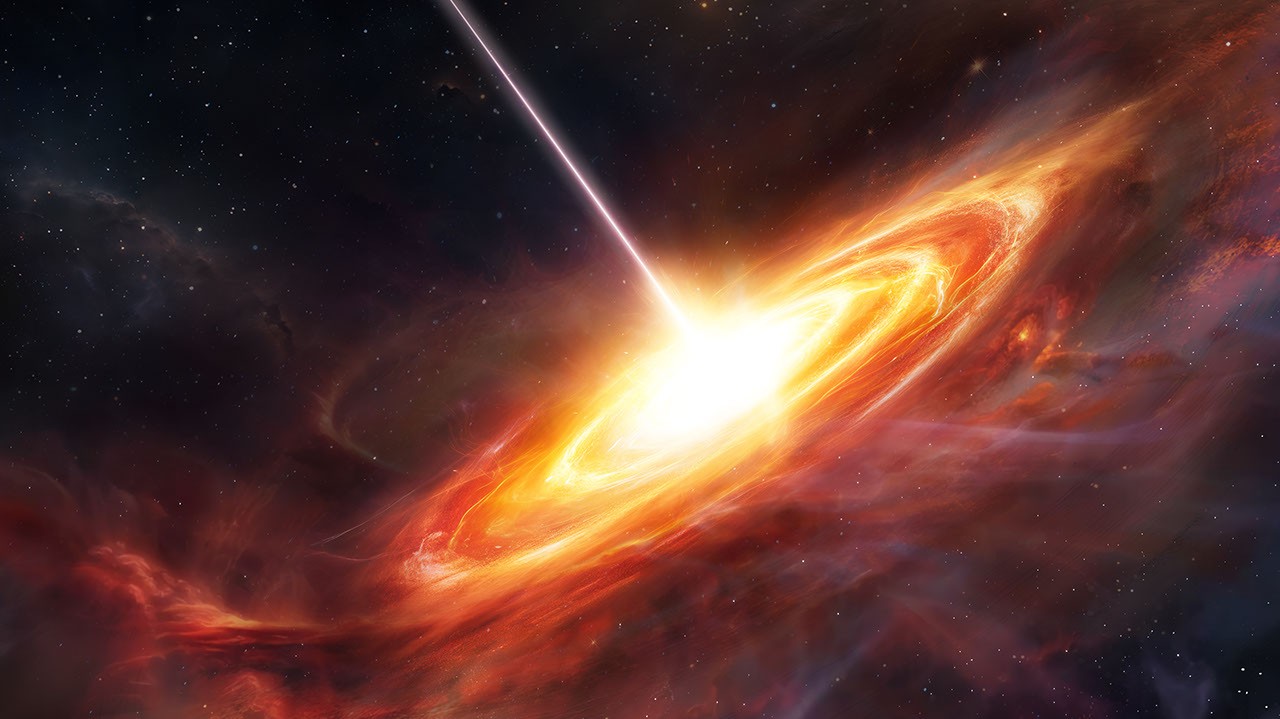
A quasar occurs when immense amounts of gas and dust fall into a supermassive black hole, spiraling around before entering. The extreme gravitational and frictional forces involved in this process heat the gas and dust to millions of degrees, releasing enormous amounts of energy. The result is a brilliant luminosity.
But quasars as old as those documented in the new study are difficult to spot: Because of their great distance, their light is faint and hard to distinguish from starlight. The 31 imaged by Euclid include 12 that date to the first 770 million years of the universe. Two others — the oldest ever documented — formed during the universe’s first 670 million years, and their light has taken some 13 billion light-years to reach Earth.
By studying them, astronomers can learn more about how the earliest galaxies and black holes formed.
The Euclid mission is imaging billions of galaxies to improve astronomers’ understanding of “dark energy,” the phenomenon that is causing our universe to expand at an accelerating rate. Euclid’s findings will help inform plans for NASA’s forthcoming Nancy Grace Roman Space Telescope, which will offer more insights into the mystery of dark energy.